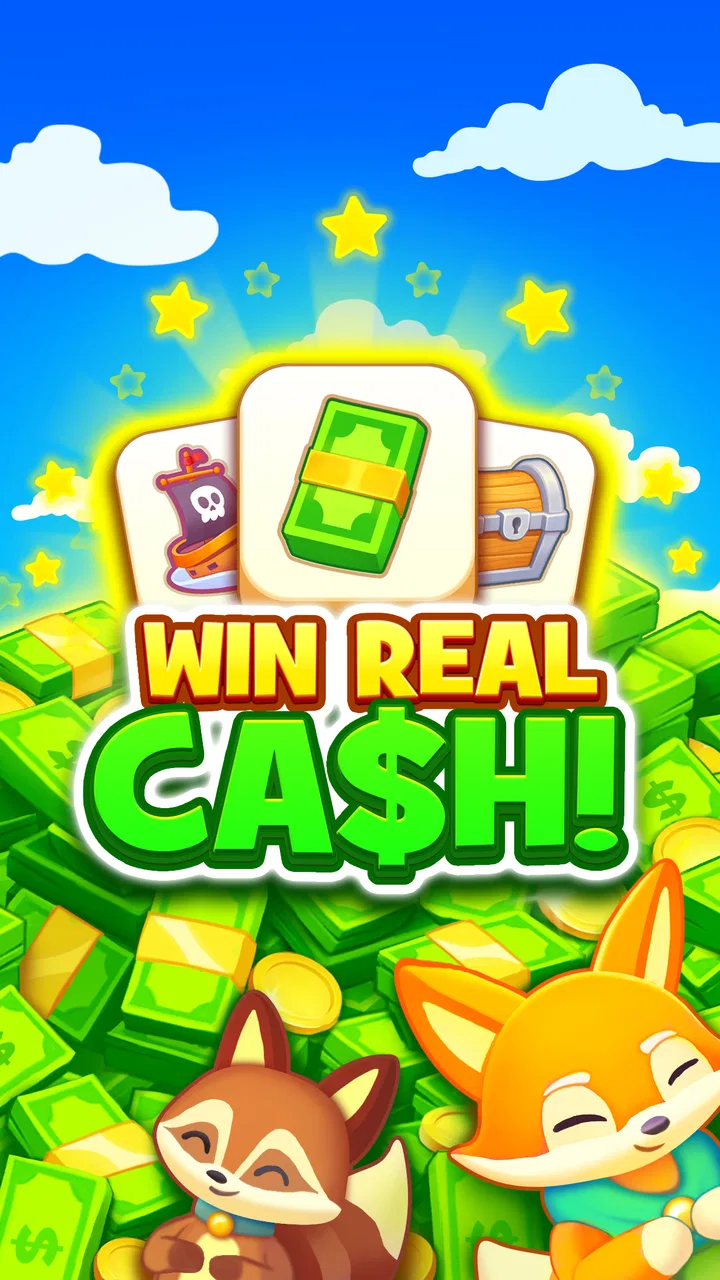
Treasure Tiles: Win Cash
- 4.6
- Rating
- 1.00M
- Installs
- Free
- Price
 Analysis by App-foxy
I spent time with Treasure Tiles: Win Cash as a puzzle game built around matching tiles and the promise of real-money rewards. That combination immediately makes it feel different from a standard relaxing puzzle app. The basic appeal is easy to understand: open the game, work through tile puzzles, and see whether your play can lead toward a cash-related reward. The more important question is whether the moment-to-moment puzzle experience remains enjoyable when the reward promise is removed from the picture. In my experience, that is the right way to judge it.
The game comes from Bear Hug Entertainment Limited and is free to download. It sits in the mature 17+ bracket, which is worth taking seriously because this is not simply a child-friendly matching game with a treasure theme. The store summary presents it as a real-money game, while the short description reduces the idea to “Treasure Tiles.” Those two phrases together set an expectation of short puzzle sessions with a financial incentive in the background, rather than a large adventure or story-driven production.
Its audience is already substantial, with more than a million installs and an average score of 4.6 from roughly ninety-one thousand ratings. Those figures suggest that the central loop is easy for many players to pick up. They do not, by themselves, guarantee that every player will enjoy the reward structure, so I paid particular attention to the pacing, the sense of progress, and the points where the cash angle can become more important than the puzzle itself.
You May Also Like

 Blood Strike: 2.5 Anniversary
Blood Strike’s Loadouts Turn Every Drop Into a Tactical Gamble
A close look at Blood Strike’s custom loadouts: how fast access to signature weapons reshapes its battle royale rhythm, rewards preparation, and narrows the gap between fights.

 Pandora - Music & Podcasts
Pandora’s Music Is Easy to Start, but Harder to Recover
Pandora’s strength is its low-effort path from a seed to a station. Its weak spot is how much confidence it asks you to place in connection, setup, and quiet recovery.

 8 Ball Pool
 Is Built on Rivalries, Rematches, and Routine
A close look at the rivalries, rematches, shared routines, and unanswered safety questions that turn a quick pool match into a persistent mobile community.

 Samsung Music
’s Quiet Strength Is Playing What You Already Own
Its reach comes less from spectacle than from dependable access to a personal library. That simplicity is both the app’s strongest retention engine and its ceiling.

 AccuWeather: Weather Radar
AccuWeather Review: A Quick, Clear Forecast for Everyday Decisions
For everyday plans, the best forecast is the one you can understand quickly. AccuWeather makes rain timing, radar, and local conditions easy to act on, with a few trade-offs.

 Hill Climb Racing
Why Hill Climb Racing Still Turns Crashes Into One More Run
A tiny car, a bumpy hill and one more upgrade: Hill Climb Racing keeps resurfacing because its simple chaos makes every near-miss feel personal.
More From Our News Desk



How the early goals shape the first sessions
The strongest part of the opening is its clarity. A tile puzzle does not need a long tutorial to explain what the player should do, and Treasure Tiles benefits from getting to the recognizable action quickly. I could approach a session with a simple goal: clear the board, make useful matches, and see what comes next. That simplicity matters on a phone, where a game often competes with a few spare minutes rather than a dedicated evening.
Early goals work best when they are close enough to feel achievable. In this game, the treasure-and-cash framing gives ordinary puzzle actions an extra sense of purpose. Clearing a difficult arrangement feels less like moving colored pieces around and more like making progress toward something. That can be motivating during the first sessions, especially for players who normally lose interest in abstract matching games.
At the same time, I would not treat the reward language as a substitute for good puzzle design. If you are downloading it only because you expect effortless earnings, you may approach every board with the wrong expectation. The game is still asking you to engage with a puzzle loop, and the entertainment value comes from making decisions under the board’s constraints. The cash theme adds pressure and curiosity, but it does not remove the need for patience.
A useful way to begin is to play the first several sessions as if the rewards were not there. Focus on whether you enjoy spotting combinations, planning a few moves ahead, and recovering from a poor choice. This gives a more honest answer than immediately chasing the most attractive reward-related objective. If the tile play itself feels satisfying, the added incentive can make the game more compelling. If the tile play feels repetitive, the promise of money is unlikely to fix that for long.
What feels rewarding before the stakes rise
The early rhythm is particularly suitable for short breaks. I can imagine opening it while waiting for an appointment, taking a few turns during a commute, or using it as a low-effort wind-down before bed. The board-based format does not demand the same attention as a long-form strategy game, yet it still gives me small decisions to make. That balance is one of the clearest reasons to try it.
There is also a psychological benefit to having a visible objective beyond simply finishing a level. Puzzle games can become interchangeable when every board is just another board. Treasure Tiles gives the session a direction through its reward-oriented presentation. The trade-off is that this direction can make a loss feel more irritating than it would in a purely casual title. A failed attempt is no longer only a missed puzzle; it can feel like delayed progress toward a desired outcome.
For that reason, I recommend setting a personal stopping point before playing. Decide whether you are giving the game ten minutes, a handful of attempts, or one relaxed session. That small habit prevents the reward framing from turning a casual game into an automatic time sink. It also helps reveal whether you are playing because the puzzles are enjoyable or because you feel pushed to continue.
Progress signals and the feeling of moving forward
Progression in a puzzle game needs to communicate more than success or failure. I want to know that my decisions matter, that later challenges are not simply copies of earlier ones, and that the game gives me a reason to return without making every session feel compulsory. Treasure Tiles is most effective when its treasure theme turns each completed stretch of play into a visible step toward a larger goal.
The important distinction is between meaningful progress and decorative progress. A reward marker can look encouraging, but it only feels valuable if I understand what it represents and what I need to do next. When a game connects puzzle completion to a reward path, I naturally look for clear milestones, understandable requirements, and a sense that my time is being respected. Any uncertainty in those areas can weaken the satisfaction of a successful board.
This is where I suggest taking a measured approach to unlocks and reward-related goals. Read the wording around each objective instead of assuming that every completed puzzle has the same value. In a game built around cash incentives, the difference between ordinary play and progress toward a particular reward matters. Treating every screen as equally important can lead to frustration when a player discovers that some actions advance the experience more directly than others.
I also found that progress signals work better when I use them as planning tools rather than promises. If a goal encourages a certain style of play, I can adjust my approach and decide whether that style remains fun. If it requires repeated attempts that stop feeling enjoyable, the sensible choice is to step away rather than chase the marker indefinitely. That is not a criticism of puzzle games in general; it is especially relevant here because the reward language can make a small objective feel more urgent than it deserves.
Unlocks should support the puzzle, not replace it
The best unlock or milestone in this kind of game is one that gives me a fresh reason to solve boards. The weakest is one that merely makes me repeat the same activity while staring at a more attractive number or treasure image. I look for a difference in challenge, a new decision, or a clearer target. Without that, the progression can feel like a wrapper around the same puzzle rather than an extension of it.
My practical advice is to judge each new goal by the quality of the play it creates. Does it make me think more carefully? Does it reward a clever sequence? Does it give a satisfying reason to finish the current session? If the answer is yes, the progression is doing useful work. If the answer is no, I would treat it as optional motivation and return to the basic puzzle only when I genuinely want to play.
This approach also helps answer a common concern: is the game suitable for someone who dislikes competitive or financially themed apps? It can be, but only if that player is comfortable treating the cash framing as background decoration rather than the main purpose. Someone who wants a completely calm, reward-free tile game will probably feel more at ease with a conventional matching title that does not place money at the center of its identity.
Challenge and the shape of the difficulty curve
A good tile puzzle should make me feel responsible for the outcome. If every board can be solved without thought, the game loses its grip quickly. If the difficulty jumps too sharply, the reward structure can make the frustration feel amplified. Treasure Tiles sits in an interesting space because its accessible format invites casual players, while its mature, real-money positioning suggests that the game wants me to take each objective seriously.
The most enjoyable challenge comes from recognizing that a quick move is not always the best move. I try to scan the board before committing, identify combinations that may disappear if I act too early, and preserve useful options for the next sequence. This is a small but important shift from tapping the first obvious match. It turns a basic tile session into a light planning exercise and gives experienced puzzle players something to engage with.
One of the more useful habits is to pause after a successful move instead of immediately repeating the same pattern. A good opening can create a poor follow-up if it removes the wrong tile or leaves an awkward arrangement. Taking a second to inspect the remaining board is especially helpful when a reward-related goal makes me want to rush. Speed can feel productive, but careful reading is often the better strategy in a puzzle that punishes wasted opportunities.
The game is not the right choice for players who want a deep, constantly changing puzzle system comparable to a large premium brain-training collection. Its appeal is narrower: quick tile-based decisions, a treasure presentation, and the extra motivation of cash-oriented goals. That focus is a strength for people who want a simple routine, but it also sets a ceiling on how much variety and strategic depth they should expect.
Where the challenge becomes less comfortable
Cash-related framing changes how I experience difficulty. In a normal free puzzle game, I can shrug off a failed attempt and move on. Here, I may start wondering whether another attempt is worth my time or whether I am being drawn into a loop by the reward promise. That does not make the challenge bad, but it means I need to separate puzzle frustration from reward frustration.
I would also avoid treating a difficult board as a reason to spend automatically. The game includes optional purchases priced from $1.99 to $9.99 for an item, so the free entry point does not mean every possible path is free of spending pressure. Before buying anything, I would ask whether the purchase improves the actual puzzle experience or merely helps me continue chasing a goal. If it is the latter, waiting is usually the better decision.
This is one of the clearest trade-offs in the design. A player who enjoys light pressure may find the reward structure energizing. A player who prefers puzzles to remain separate from money may find the same structure distracting. Neither reaction is unreasonable. The right choice depends on whether the financial theme adds motivation or makes every mistake feel like a cost.
Retention pressure and the decision to keep playing
Treasure Tiles has several natural reasons to bring me back: the short-session format, the desire to complete another board, and the curiosity created by reward-oriented progression. Those are effective retention tools because they work on different levels. One appeals to convenience, one to puzzle satisfaction, and one to the hope of reaching a larger outcome.
The risk is that these motivations can overlap in a way that encourages automatic replay. I may tell myself I am playing one more round for the puzzle, when the real reason is that I do not want to stop just before a reward milestone. Recognizing that difference is important. A game can be entertaining and still use goals that make stopping feel harder than it should.
My preferred routine is to separate play sessions from spending decisions. I can enjoy a free round when I have a few minutes, then leave the game before deciding whether any purchase is worthwhile. Making that decision away from the immediate excitement of a near-completed goal gives me a clearer view of the trade-off. It also keeps the game in the category of casual entertainment instead of allowing it to dictate my attention.
The mature age rating reinforces that caution. I would not recommend handing this to a younger player simply because the tile mechanics look harmless. The money-oriented presentation changes the context, and adults should be the ones deciding whether the reward structure is appropriate for their household. For parents, the important issue is not only the puzzle content but also the way in-app purchases can fit into the experience.
Another practical question is whether the game works for a player who has only occasional internet access or wants completely predictable offline play. I would choose a traditional offline puzzle for that need. Treasure Tiles is designed around its broader reward identity, so it makes more sense for someone comfortable with a connected, account-oriented style of casual gaming and with checking the rules of any reward path before investing serious time.
Who will enjoy the loop most
I think it suits adults who like familiar tile puzzles but want a stronger external goal than a simple score. It is also a reasonable fit for people who prefer brief sessions and enjoy making small tactical choices without learning a complicated control scheme. The free download lowers the barrier to trying it, and the current version is 5.0, so a new player can start without committing money at the outset.
I would skip it if my priority were a peaceful, ad-free-feeling puzzle atmosphere, a rich story, or a deep competitive ladder. I would also skip it if the phrase “win cash” makes me expect guaranteed income. The game should be approached as entertainment with a reward theme, not as a dependable financial activity. That distinction is the single most important expectation to set before installing it.
Compared with ordinary match-three and tile-clearing alternatives, its main difference is not necessarily the basic act of matching; it is the pressure created by the reward context. A conventional puzzle is easier to play purely for relaxation. Treasure Tiles is more motivating when I want goals and stakes, but less relaxing when I start measuring every session by what it might produce. Choosing between them comes down to whether I want calm repetition or incentive-driven repetition.
My progression verdict after playing
Treasure Tiles works best when its early goals give direction, its progress signals remain understandable, and its difficulty encourages thought without making the reward promise feel like a debt. I enjoyed the accessible tile format and the way a short session can still feel purposeful. The treasure presentation gives the game a clear identity, while the cash angle makes it stand apart from the usual casual puzzle selection.
My reservations are equally clear. The reward framing can overshadow the puzzle, and the presence of in-app purchases means I would keep a firm boundary around spending. The game is not a replacement for a reliable income source, and I would not recommend playing it with that expectation. I would also resist rushing through boards merely to reach the next progress marker; careful play is more satisfying and usually gives me a better sense of whether the challenge itself is worth returning to.
For me, the best use case is a short adult puzzle break: I open it, set a modest time limit, work through the tile challenge, and stop while the session still feels enjoyable. That workflow preserves the game’s strongest qualities without letting the retention pressure take over. If I wanted a deeper puzzle system, a quieter experience, or no money-related tension, I would choose a different category of tile game instead.
Overall, I see this as a focused free puzzle game for adults who are curious about reward-driven play and willing to judge it on two separate levels. The first is simple: are the tile decisions fun? The second is more personal: does the cash-oriented progression motivate me without making me feel pressured? If both answers are yes, Bear Hug Entertainment Limited has created an engaging enough reason to return. If only the second answer is yes, I would move on, because the strongest reason to keep playing should be enjoyment of the puzzle, not the hope of an easy payout.
FAQs for Treasure Tiles: Win Cash
01What is Treasure Tiles: Win Cash and how does it work?
Treasure Tiles: Win Cash is a tile-matching puzzle game built around short, casual levels and reward-focused gameplay. You usually clear matching tiles, complete objectives, and progress through increasingly challenging boards. The app may present coins, points, bonuses, or cash-style rewards as part of its experience. Before downloading, remember that advertised rewards can depend on eligibility, availability, and the app’s current terms.
02Can you really win real money with Treasure Tiles: Win Cash?
The game may promote opportunities to earn cash or redeemable rewards, but players should not assume that every in-game coin has real monetary value. Reward systems often include minimum withdrawal limits, verification requirements, regional restrictions, and limited availability. Based on the way these games are generally structured, treat the cash feature as an optional incentive rather than a guaranteed source of income, and carefully read the withdrawal rules before investing significant time.
03Is Treasure Tiles: Win Cash free to download and play?
Treasure Tiles: Win Cash is generally presented as a free-to-download mobile game, allowing you to start playing without paying an upfront purchase price. However, free games commonly include advertising, optional in-app purchases, or offers connected to additional turns, boosters, and rewards. Your actual experience may vary by device and region, so check the store listing for current pricing, subscriptions, and payment information before confirming the download.
04Does Treasure Tiles: Win Cash require an internet connection?
An internet connection is likely needed for several important features, including advertisements, account or reward synchronization, leaderboard updates, promotional events, and cash-out processing. Some puzzle rounds may appear to work temporarily offline, but progress or rewards might not register until the app reconnects. For the most reliable experience, use a stable connection and avoid uninstalling or clearing app data while a withdrawal or account update is still pending.
05Is Treasure Tiles: Win Cash safe for children and personal data?
Parents should review the game’s age rating, privacy policy, advertising practices, and permission requests before allowing children to use it. Reward-based games can include frequent ads, external links, purchase prompts, and requests for information during account verification or withdrawals. Only provide details that are genuinely required, never share payment credentials casually, and use device-level parental controls if younger players will access the application.
Pros
- Simple tile-matching gameplay is easy to learn and play casually.
- Short rounds make it convenient for quick breaks.
- Bright visuals and clear tap controls suit mobile screens.
- Progress rewards can add motivation during repeated play.
- Free access lets users try the core game without paying upfront.
Cons
- Cash-out eligibility may depend on minimum thresholds and regional rules.
- Earnings can be small compared with the time required to play.
- Frequent ads may interrupt rounds or slow down progression.
- Some rewards may require watching videos or completing extra tasks.
- Availability of cash prizes can vary by country and user eligibility.

Treasure Tiles: Win Cash
Gallery